

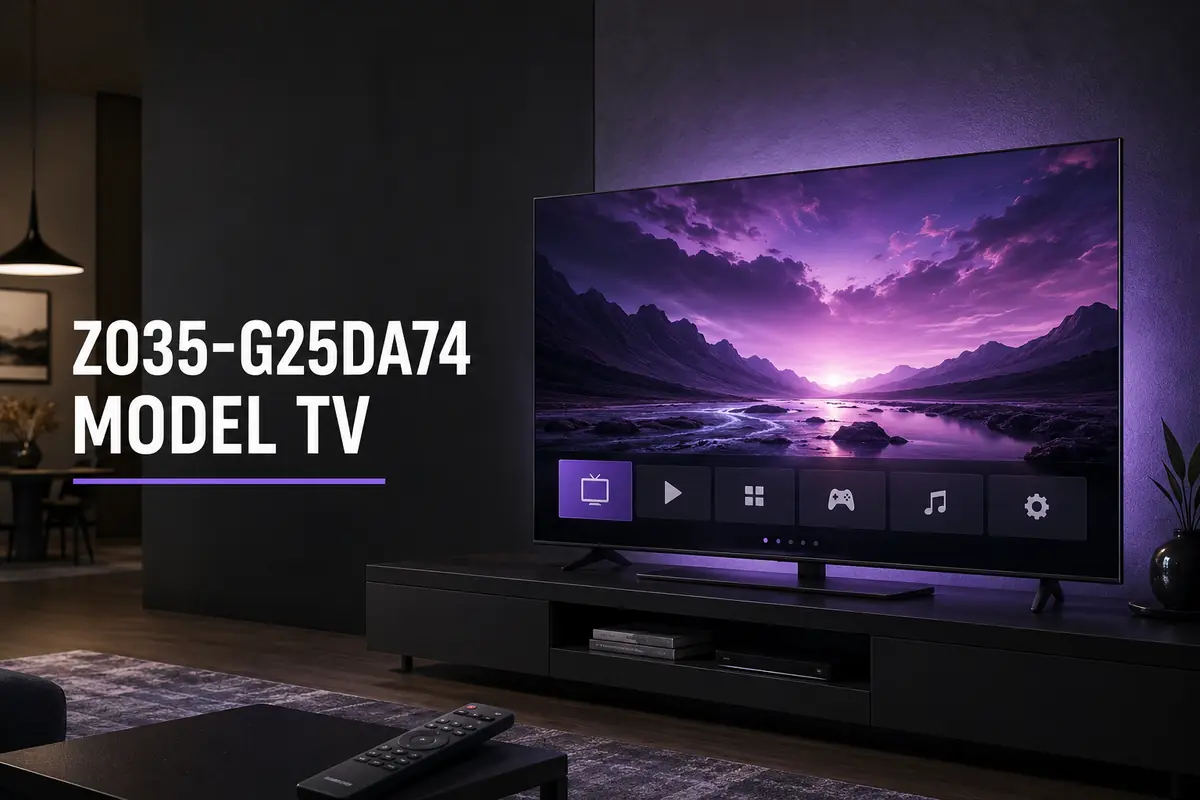
The ZO35-G25DA74 has appeared across technology websites as a smart television model aimed at everyday streaming, gaming, and home entertainment. Some articles describe it as an affordable 4K television, while others connect it with different screen sizes, display technologies, and smart platforms. However, no clearly verified manufacturer page, official product manual, or consistent retail listing supports all these claims.
Anyone considering this television should examine the label, seller information, warranty, and technical documentation before making a purchase. This guide explains what buyers should verify, how to assess picture and sound quality, which connections matter, and how to avoid paying for features that may not be included.
What Is the ZO35-G25DA74?
The product name appears to follow the style of a television model code. Nevertheless, it does not match the familiar naming systems used in the public product catalogues of major television manufacturers. Online sources also disagree about whether it belongs to a recognized brand, a regional manufacturer, a private-label seller, or an incorrectly identified product.
A model code should lead to a consistent set of specifications, including the brand, screen size, panel type, native resolution, manufacturing date, supported voltage, and serial number. If those details cannot be found on the television’s rear label, original packaging, manual, or warranty card, buyers should not depend on promotional articles alone.
Why Accurate Model Identification Matters
Televisions that look similar can use different display panels, processors, remote controls, mainboards, power supplies, and operating systems. Correct identification is therefore essential when checking compatibility, ordering replacement parts, updating software, or arranging a repair.
An inaccurate model number may lead to the wrong wall mount, remote, firmware package, or power cable. Installing firmware created for another television can cause serious software failure. Always copy the complete model code from the physical label rather than relying on a handwritten listing or online advertisement.
Check the Manufacturer Before Buying
A legitimate television should clearly identify its manufacturer or legal distributor. Look for the company name on the rear label, startup screen, packaging, user manual, warranty document, and settings menu. These details should match each other.
Search for the manufacturer’s support department and confirm that it recognizes the model. A functioning support system should provide contact information, warranty terms, safety documents, and technical assistance. If the seller cannot identify who produced or supports the television, future repairs and software updates may become difficult.
Verify the Screen Size
Different websites associate the ZO35-G25DA74 with different screen sizes. Therefore, no particular measurement should be assumed without checking the product itself. Television size is measured diagonally across the visible screen, excluding the outer frame.
The correct screen size affects viewing distance, furniture placement, wall mounting, and price. Measure the available space before buying, including room for the stand and cable connections. Also check the television’s complete width and height because two screens with the same diagonal measurement can have slightly different outer dimensions.
Confirm the Native Resolution
A seller may use terms such as HD, Full HD, 4K, or Ultra HD, but the native panel resolution should appear in the manual or official specifications. A 4K television normally has a resolution of 3840 × 2160 pixels. Marketing phrases about enhanced clarity do not automatically confirm a genuine 4K panel.
Ask the seller to display the system information screen and play suitable high-resolution content. Keep in mind that a low-quality video can look soft even on a capable screen. Likewise, image processing can improve lower-resolution material without changing the panel’s native resolution.
Understand the Display Technology
Television listings commonly mention LED, QLED, Mini-LED, or OLED. These terms describe different display or backlighting technologies, and they should not be used interchangeably. Standard LED televisions typically use an LCD panel with an LED backlight, while OLED panels produce light at the individual-pixel level.
There is no reliable documentation confirming which panel technology this model uses. Buyers should request an official specification sheet instead of accepting an unsupported description. The panel type influences black levels, brightness, viewing angles, response time, power consumption, and long-term performance.
Examine Picture Quality in Person
Specifications do not always reveal how a television looks during normal use. View the screen from the front and from both sides. Check skin tones, dark scenes, bright highlights, subtitles, and fast movement. Poor viewing angles can make colors fade when people sit away from the center.
Inspect the panel for dead pixels, bright spots, dark corners, color patches, and uneven backlighting. Use several types of content rather than a colorful demonstration video. Store demos often hide weaknesses by using bright, highly saturated footage that rarely resembles everyday viewing.
Check Brightness and Room Conditions
A television used in a bright living room needs enough brightness to remain visible during the day. Reflections from windows and lamps can reduce contrast, especially on glossy screens. A model that looks attractive in a dark showroom may struggle in a sunlit room.
Ask whether the screen includes an effective anti-reflection coating and adjustable backlight controls. For evening viewing, accurate black levels and controlled brightness can matter more than maximum output. The best choice depends on the room rather than the largest brightness figure printed on a box.
Review Motion Performance
Sports, action films, and games can expose weaknesses in motion handling. Watch moving text, camera pans, football matches, and fast objects to check for blur, judder, ghosting, or distracting image trails.
Do not confuse software-generated motion effects with the panel’s native refresh rate. A television may advertise a high motion number even when its actual panel runs at a lower frequency. Request written confirmation of the native refresh rate if gaming or sports performance is important.
Investigate the Smart TV Platform
A smart television should provide a clear interface, dependable app support, stable Wi-Fi, and regular security updates. Confirm the exact operating system installed on the ZO35-G25DA74 rather than assuming that it uses Android TV, Google TV, Tizen, webOS, or another familiar platform.
Open the app store and search for the streaming services you actually use. An app logo on the box does not guarantee continued support. Check whether applications launch quickly, play video correctly, and receive updates. An unsupported platform may gradually lose access to popular services.
Check Streaming Performance
Connect the television to a normal home network and test several streaming applications if possible. Menus should respond without long delays, videos should begin smoothly, and the television should maintain its connection after restarting.
Weak streaming performance may come from limited processing power, small internal storage, poor Wi-Fi hardware, or outdated software. An external streaming device can improve an older television, but buyers should include that extra cost when judging the overall value.
Examine HDMI and USB Connections
Count the available HDMI ports and confirm their location. A home setup may need separate connections for a game console, streaming device, satellite receiver, computer, and sound system. Side-facing ports are often easier to reach after wall mounting.
USB ports can support media playback, service functions, or low-power accessories, but their capabilities vary. Do not assume that every USB port can record television, power a device, or read all storage formats. These functions should be confirmed through the manual.
Check ARC and eARC Support
ARC allows a television to send sound to a compatible soundbar or receiver through an HDMI cable. eARC offers greater audio bandwidth and can support more advanced formats when both connected devices provide compatible features.
Confirm which HDMI port carries ARC or eARC and whether it functions correctly. The label should appear beside the physical port or inside the manual. If neither feature is available, optical audio may provide an alternative connection for external speakers.
Review Wireless Connectivity
Smart televisions commonly include Wi-Fi, while some models also provide Bluetooth and Ethernet. Wi-Fi enables streaming and software updates, Bluetooth may connect headphones or speakers, and Ethernet can offer a more stable network connection.
Test each required connection rather than trusting a general “wireless” description. Bluetooth support may be limited to the remote control instead of audio devices. Similarly, a television may support only certain Wi-Fi bands, which can affect performance in crowded networks.
Evaluate the Built-In Sound
Thin television bodies leave limited space for large speakers. Built-in audio may provide clear speech but weak bass and a narrow soundstage. Listen to dialogue, music, and action scenes at several volume levels before deciding whether the speakers are adequate.
Check for buzzing, distortion, sudden volume changes, or unclear voices. If an external soundbar is necessary, confirm that the TV has a compatible HDMI ARC, eARC, optical, or analogue output. The price of additional audio equipment should become part of the buying budget.
Assess Gaming Features Carefully
Gaming performance depends on more than resolution. Input lag, refresh rate, response time, HDR handling, HDMI bandwidth, Variable Refresh Rate, and Auto Low Latency Mode can all affect the experience.
Some online pages describe the model as suitable for gaming, but dependable measurements are not available. Console owners should test Game Mode and confirm which resolutions and refresh rates each HDMI input accepts. Competitive players may prefer a television with independently measured input lag and clearly documented HDMI features.
Inspect the Remote and Controls
A television remote should provide dependable navigation, input selection, volume control, and quick access to important settings. Check whether the original remote is included, especially when buying a used or open-box television.
Voice control requires more than a microphone button. It may depend on a supported operating system, an internet connection, an account, and availability in the user’s country. Buyers should confirm these conditions before treating voice assistance as a major feature.
Confirm Wall-Mount Compatibility
Do not purchase a bracket based only on an online article. Check the VESA mounting pattern printed in the manual or measure the horizontal and vertical spacing between the threaded holes on the back of the television.
The bracket must support the television’s weight and screen size. Use bolts of the correct diameter and length because overly long bolts can damage internal parts. Large or heavy televisions should be mounted by someone who understands the wall structure and appropriate fixings.
Understand Energy Consumption
Television power consumption depends on screen size, panel technology, brightness, picture mode, and daily viewing time. Look for a recognized energy label or rated power figure on the rear panel.
Energy-saving modes can lower brightness and power use, but aggressive settings may reduce picture quality. Compare estimated annual consumption with similar televisions of the same size. Standby consumption also matters when the television remains connected throughout the year.
Examine Warranty Coverage
Warranty terms are especially important for a product whose manufacturer is not immediately clear. Confirm the coverage period, responsible service company, claim process, repair locations, and parts policy before paying.
A seller’s verbal promise provides limited protection if it does not appear on the receipt or warranty document. Keep the invoice, serial number, packaging photographs, and written terms. Buyers should also confirm whether opening the box, wall mounting, or using the television commercially affects coverage.
Check a Used Television Thoroughly
When buying a used ZO35-G25DA74, inspect it while powered on for at least 20 to 30 minutes. Heat-related faults, flickering, restarts, and audio problems may not appear immediately. Test every HDMI port, USB connection, speaker, button, wireless feature, and remote-control key.
Display solid white, grey, red, green, blue, and black images to reveal panel defects. Examine the screen under normal room lighting for scratches or pressure marks. A factory reset should be completed so the previous owner’s accounts and settings are removed.
Avoid Unverified Firmware Downloads
Never install a software update from a third-party website merely because the filename looks similar. Television firmware is closely tied to the exact mainboard, region, panel, and hardware revision. The wrong package can stop the TV from starting.
Use only an update supplied through the television’s built-in menu or a verified manufacturer support page. Keep the television connected to stable power during the process. Do not unplug it unless the official instructions specifically say that the update has finished.
Common Problems to Test
Potential problems in any smart television include lost Wi-Fi connections, slow applications, failed HDMI ports, remote-control delays, audio sync errors, backlight patches, random restarts, and lines across the screen. These are general checks and should not be presented as known defects of this model without reliable service data.
A factory reset may solve configuration problems, but it cannot repair failed hardware. If a new television shows panel defects or repeated crashes, use the return policy instead of attempting unofficial repairs during the warranty period.
How to Decide Whether It Is Worth Buying
The television may be worth considering only when its physical label, manufacturer, specifications, condition, warranty, and price can all be verified. Compare it with clearly documented alternatives in the same screen-size and price category.
Do not pay extra for claimed 4K resolution, HDR, voice control, advanced gaming, or premium display technology without seeing evidence that those features exist and work properly. A dependable basic television can be a better purchase than an unknown model promoted with unsupported specifications.
Final Verdict
The available information about ZO35-G25DA74 is too inconsistent to support a conventional product review. Online sources disagree about its brand, screen size, release period, smart system, display type, gaming support, and warranty. These contradictions make direct inspection and documentation essential.
Buyers should identify the manufacturer, read the rear label, test the screen, verify every required connection, and obtain written warranty terms. Until an official product page or manual can be confirmed, it is safer to treat the model as an unidentified or region-specific television rather than a proven mainstream smart TV.
FAQs
Is ZO35-G25DA74 a Samsung television?
No dependable manufacturer listing confirms that connection. Check the brand and company details printed on the actual television and its original documents.
Does the television have a 4K screen?
Some websites claim 4K support, but an official specification sheet is not available. Confirm the native resolution through the product menu and manual.
Is it suitable for gaming?
That depends on its measured input lag, native refresh rate, Game Mode, and HDMI capabilities. These features should be tested before purchase.
Can it connect to Wi-Fi and Bluetooth?
Online claims vary, so wireless support should be checked directly in the network and audio settings of the physical television.
Is the model worth buying?
It may be suitable if the specifications, condition, warranty, and price are verified. Avoid buying it solely on the basis of unsupported online descriptions.