

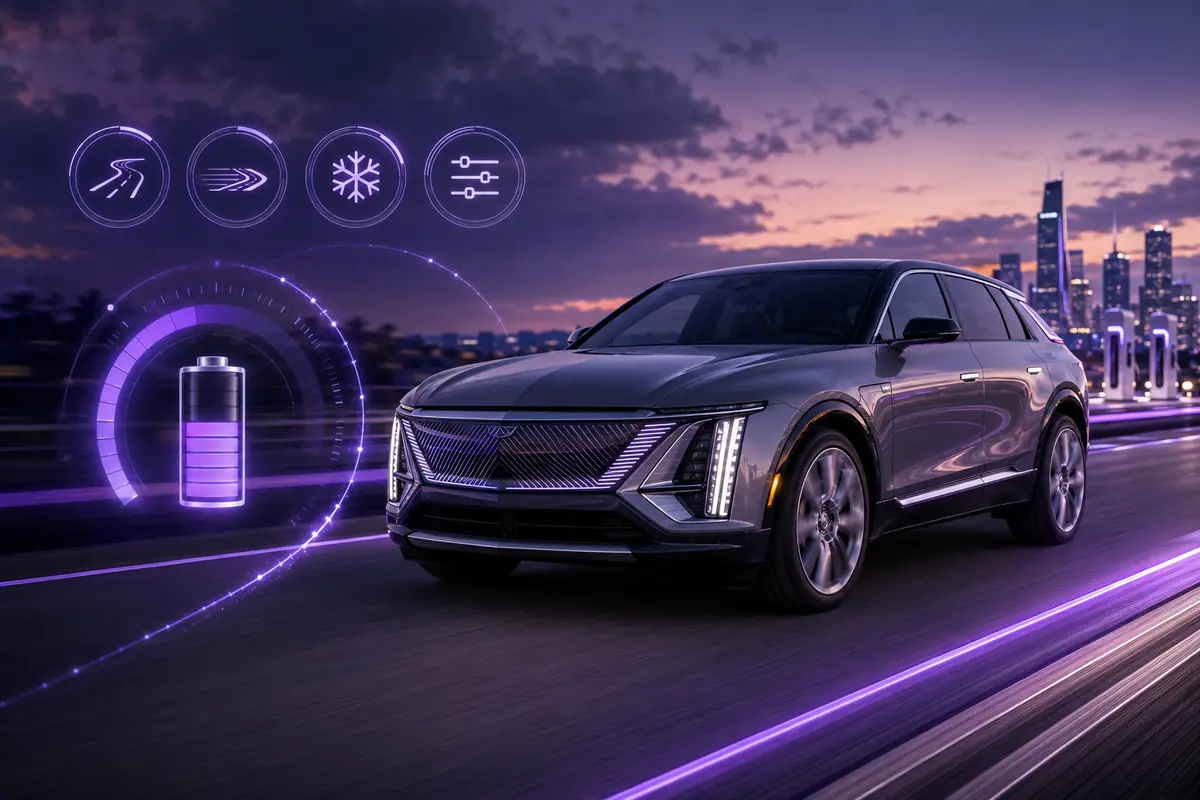
Do the driving modes in Cadillac LYRIQ offer different ranges or battery usages? The short answer is that the modes do not unlock separate battery capacities or provide fixed range ratings. However, they can influence real-world energy consumption by changing accelerator response, traction behavior, steering feel, and the way a driver operates the vehicle. Tour mode generally supports smooth, predictable driving, while Sport mode may encourage stronger acceleration. Snow/Ice mode manages torque more carefully on slippery roads. Therefore, the driver’s behavior within each mode matters more than the selected mode alone.
How Cadillac LYRIQ Driving Modes Work
The Cadillac LYRIQ uses Driver Mode Control to adjust how the electric SUV responds to different road conditions and driving preferences. Depending on the model year and configuration, the available choices may include Tour, Sport, Snow/Ice, and My Mode. Performance-focused LYRIQ-V models can offer additional settings. These modes change selected vehicle responses, but they do not divide the battery into separate sections or alter its total usable capacity.
Selecting a driving mode may adjust accelerator sensitivity, steering effort, traction control, and other performance settings. For example, Sport mode can make the accelerator feel more responsive even though the electric motors and battery remain the same. Meanwhile, Snow/Ice mode softens the response to help control wheel spin. Consequently, the mode changes how the vehicle delivers power rather than how much electricity the battery can store.
Does Tour Mode Provide the Longest Range?
Tour mode is the standard choice for ordinary streets, commuting, and highway travel. It provides balanced accelerator response and comfortable steering, making smooth driving easier. Because the accelerator does not feel unusually aggressive, many owners may find it simpler to maintain steady speeds and avoid unnecessary bursts of power. Those habits can support lower energy consumption and a more stable range estimate.
However, Cadillac does not assign a separate EPA range figure to Tour mode. The LYRIQ’s published range depends on its model year, drivetrain, wheels, tires, and testing configuration. For example, Cadillac lists an EPA-estimated range of up to 326 miles for certain rear-wheel-drive versions, but actual range varies. Tour mode may help a careful driver approach the vehicle’s expected efficiency, yet it cannot guarantee a particular number of miles.
Does Sport Mode Use More Battery Power?
Sport mode sharpens the LYRIQ’s responses and gives the vehicle a more energetic character. The accelerator may respond more quickly, while the steering can feel heavier or more direct. These changes do not continuously force the motors to consume additional electricity. If a driver selects Sport mode and maintains the same steady speed with the same climate settings, the difference in battery use may remain small.
In practice, Sport mode often leads to greater consumption because its faster response encourages harder acceleration and higher speeds. Strong acceleration requires the battery to deliver more power, while high-speed travel increases aerodynamic drag. Frequent acceleration followed by braking also creates energy losses, even when regenerative braking recovers some electricity. Therefore, Sport mode can reduce real-world range when the driver regularly uses the extra responsiveness it provides.
How Snow/Ice Mode Affects Battery Usage
Snow/Ice mode changes the accelerator mapping so torque arrives more gradually. Cadillac explains that the mode is designed to reduce wheel slip and improve control on slippery surfaces. A softer pedal response can prevent wasteful tire spin, which may help the vehicle use its available energy more effectively when traction is poor. Still, the purpose of Snow/Ice mode is safety and stability rather than maximum driving range.
Cold weather itself usually has a much greater effect on range than Snow/Ice mode. A cold battery may operate less efficiently, while cabin heating, window defrosting, and heated accessories draw energy. Snow, standing water, strong winds, and winter tires may also increase resistance. As a result, drivers can see a lower range estimate while using Snow/Ice mode, but the temperature and road conditions are normally responsible for most of that loss.
Does My Mode Change the LYRIQ’s Range?
My Mode allows the driver to personalize certain settings instead of accepting one complete preset. Available adjustments can vary by model year, but they may include steering feel, braking response, acceleration characteristics, and other driving preferences. This flexibility lets an owner combine a comfortable steering setting with a different accelerator or braking response.
My Mode does not come with its own official range rating. Its effect depends on the chosen settings and the driver’s actions. A responsive accelerator combined with repeated hard launches can increase consumption. Conversely, a calm driving style with gradual acceleration may return efficiency similar to Tour mode. For that reason, the mode’s name or menu position cannot predict battery usage without considering how the vehicle is actually driven.
Driving Modes Do Not Change Battery Capacity
Every normal driving mode accesses the same installed high-voltage battery. Changing from Tour to Sport does not increase the battery’s usable capacity, and switching to Snow/Ice does not reserve extra electricity for bad weather. The battery-management system continues to protect the pack, monitor temperature, and control power delivery regardless of the selected mode.
The displayed range can still rise or fall after a mode change because the LYRIQ continuously estimates how far it may travel. That calculation considers recent energy consumption, battery charge, climate-control demand, temperature, and driving conditions. If Sport mode leads to aggressive driving, the estimate may fall faster. If the driver later slows down and uses energy more efficiently, the predicted range may gradually improve.
One-Pedal Driving and Regenerative Braking
One-Pedal Driving is separate from the LYRIQ’s main driving modes. It allows the vehicle to slow significantly when the driver lifts off the accelerator. During deceleration, the electric motors act as generators and send some recovered energy back to the battery. The driver can choose the available regeneration level through the vehicle’s settings, although the precise options may differ across model years.
Regeneration improves efficiency by recovering energy that conventional friction brakes would turn into heat. However, it cannot recover every unit of energy used during acceleration. The most efficient strategy remains smooth driving with good anticipation. Gradually easing off the accelerator before traffic slows is usually better than accelerating hard and relying on strong regeneration to recover the loss.
Regen on Demand and Energy Recovery
The LYRIQ also provides Regen on Demand through a pressure-sensitive control on the steering wheel. The driver can use it to slow the vehicle while capturing some kinetic energy. It can be helpful when approaching slower traffic, descending a hill, or preparing for a turn. However, it requires practice because the amount of deceleration depends on how the driver uses the control.
Regen on Demand does not create additional electricity from nothing. It only recovers part of the energy already used to move the vehicle. Moreover, regenerative braking may be limited when the battery is very full, extremely cold, or operating under certain system conditions. Drivers should always remain prepared to use the brake pedal because regenerative features do not replace the vehicle’s regular braking system.
What Affects Cadillac LYRIQ Range the Most?
Speed has one of the strongest effects on electric-vehicle range. At higher speeds, the motors must work harder to overcome aerodynamic resistance. Quick acceleration, steep climbs, heavy cargo, roof-mounted equipment, low tire pressure, and repeated short trips can also raise energy consumption. The U.S. Department of Energy notes that aggressive driving, heavy loads, and extreme temperatures can reduce an electric vehicle’s real-world range.
Heating and air conditioning also use electricity from the high-voltage battery. The impact becomes more noticeable during very hot or cold weather. Preconditioning the cabin while the LYRIQ remains connected to a charger can reduce the initial demand placed on the battery. In addition, using heated seats and the heated steering wheel may sometimes require less energy than maintaining a very high cabin temperature throughout the journey.
Why Wheel Size and Drivetrain Matter
Two LYRIQ vehicles driven in the same mode may not achieve identical range. Rear-wheel-drive and all-wheel-drive versions use different propulsion arrangements, while larger wheels and performance-oriented tires can affect rolling resistance and aerodynamic efficiency. Model year, equipment, battery condition, passenger load, and tire pressure can create further differences.
This is why a driver should compare energy consumption under similar conditions instead of judging a mode after one short trip. A journey made in Tour mode during freezing weather may consume more electricity than a mild-weather trip in Sport mode. To make a useful comparison, the route, temperature, speed, traffic, tire pressure, climate settings, and passenger load should remain as consistent as possible.
Best Driving Mode for Maximum Cadillac LYRIQ Range
Tour mode is the most practical starting point for drivers who want predictable efficiency. It promotes a balanced response suitable for normal commuting and longer journeys. However, no setting can compensate for sustained high speeds, aggressive acceleration, low tire pressure, or heavy climate-control use. Smooth operation remains the central factor.
For maximum range, accelerate gradually, maintain a reasonable speed, anticipate stops, and use regenerative braking smoothly. Keep the tires at the recommended pressure and remove unnecessary exterior carriers when they are not needed. Before a cold or hot trip, precondition the cabin while connected to power. These steps can influence battery consumption more noticeably than simply changing the driving mode.
The Final Answer on Driving Modes and Range
So, do the driving modes in Cadillac LYRIQ offer different ranges or battery usages? They can produce different real-world results, but Cadillac does not provide a fixed range figure for each mode. The modes mainly adjust vehicle response, traction behavior, and driving feel. Sport mode can consume more energy if it leads to harder acceleration, while Tour mode often makes efficient driving easier.
Snow/Ice mode may limit wheel spin through gentler torque delivery, but winter temperatures and cabin heating can still reduce range. My Mode depends entirely on its selected settings and the driver’s habits. Ultimately, driving speed, acceleration, weather, climate control, tires, road conditions, and vehicle configuration determine range more strongly than the mode label displayed on the screen.
FAQs
Does Sport mode always reduce Cadillac LYRIQ range?
No. Sport mode does not automatically drain the battery faster at a steady speed. However, its sharper response can encourage rapid acceleration, which raises energy consumption.
Which LYRIQ mode is best for battery efficiency?
Tour mode is generally the best everyday choice because it offers smooth, balanced responses. Still, careful driving matters more than the selected mode.
Does Snow/Ice mode save battery power?
Snow/Ice mode can reduce unnecessary wheel spin, but it is designed mainly for traction. Cold temperatures and cabin heating may still lower the vehicle’s range.
Can One-Pedal Driving increase the LYRIQ’s range?
It can improve efficiency by recovering energy during deceleration. However, smooth acceleration and anticipating traffic provide better results than relying only on strong regeneration.
Why does the LYRIQ range estimate keep changing?
The estimate responds to recent driving, speed, temperature, climate use, battery charge, terrain, and road conditions. Therefore, it naturally changes throughout a journey.