

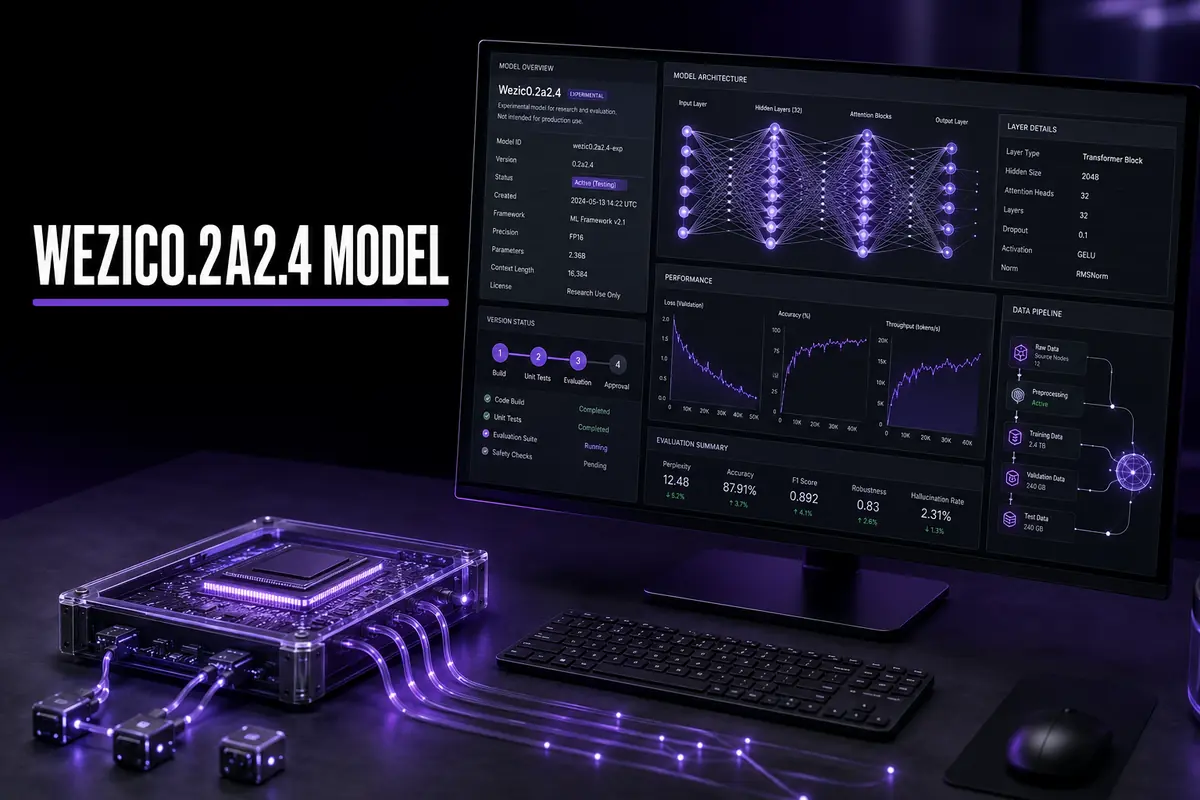
The Wezic0.2a2.4 Model appears online as a technical identifier connected with artificial intelligence, experimental software, model development, and version tracking. Its structured name makes it look like a specific release, but publicly available information does not confirm its developer, architecture, purpose, download location, or official documentation.
Rather than inventing specifications, this guide explains what the identifier may represent, how developers normally read similar version labels, and what evidence should exist before anyone uses an unfamiliar model. It also covers testing, security, compatibility, performance, and possible development use cases.
What Is Wezic0.2a2.4?
Wezic0.2a2.4 is not currently recognized as a mainstream commercial AI model, public software package, hardware product, or established research project. Searches for the exact name mainly lead to explanatory blog posts rather than an official website, source-code repository, model card, or academic publication.
The name could be an internal project label, experimental build, private model checkpoint, test package, or fictional identifier used in online content. Without primary documentation, no specific function should be presented as confirmed. Claims about its speed, accuracy, training data, architecture, or supported tasks remain assumptions.
Understanding the Name
The identifier contains two parts: “Wezic,” which may be a project or family name, and “0.2a2.4,” which resembles a development version. Software teams often combine a product name with numbers and letters to distinguish releases.
However, naming systems are chosen by developers and are not universal. The label can suggest a development stage, but only the project owner can define its exact meaning. Users should not assume that every number represents a particular feature or engineering change.
What the 0.2 Prefix May Mean
In many development projects, a version beginning with zero indicates that the software has not reached its first stable public release. A label such as 0.2 may represent a second early development phase following an initial prototype.
That interpretation is common but not guaranteed. Some mature projects continue using 0.x version numbers for years, while others use completely different rules. The number alone cannot confirm whether a model is safe, reliable, or ready for production.
What the “a2” Segment May Indicate
The letter “a” commonly means alpha in software versioning. Alpha builds are usually released for early testing while features, interfaces, dependencies, and behavior may still change. The number two may identify the second alpha stage or revision.
If this interpretation is correct, the release would be more appropriate for experiments than mission-critical systems. Alpha software can contain incomplete functions, unstable outputs, security weaknesses, and compatibility changes. Yet this remains an interpretation until official notes define the label.
What the Final “.4” May Represent
The final number might identify a fourth patch, build, checkpoint, or internal iteration within the alpha release. Development teams often create several small revisions while fixing errors, adjusting settings, or comparing experimental results.
It would be inaccurate to claim that “.4” definitely includes four bug fixes or follows three public releases. A proper changelog should describe what changed, which problems were solved, and whether compatibility was affected.
Why Model Names Need Documentation
A version number is useful only when it connects to clear documentation. A proper release should include the developer’s identity, publication date, intended purpose, license, change history, system requirements, dependencies, limitations, and installation instructions.
AI releases require additional information, including model architecture, parameter count, training approach, supported input and output formats, evaluation results, safety limitations, and hardware needs. Without these details, users cannot make a reliable technical assessment.
How to Confirm Whether It Is Real
When you encounter the Wezic0.2a2.4 Model in a file, article, system log, or project folder, record the complete context. Note the filename, extension, directory, application, error message, download source, and any nearby developer information.
Search for the exact identifier on official package registries, model-hosting platforms, research databases, and source-code services. A genuine public project should normally leave a trace beyond repeated blog descriptions. Internal software may not be public, but the organization using it should still provide private documentation.
Look for a Model Card
A model card explains how an AI system was developed and how it should be used. It usually describes the model’s intended tasks, supported languages, evaluation results, limitations, ethical considerations, and known risks.
The absence of a model card does not prove that a project is unsafe, especially if it is private or experimental. Nevertheless, it prevents users from judging whether the model suits a particular workload. Production use should not begin until equivalent documentation is available.
Verify the Download Source
Do not download a file simply because its name matches an online keyword. Technical-looking filenames can be used to disguise unwanted or malicious software. Confirm that the file comes from the actual developer, an approved company repository, or a recognized package platform.
Check its digital signature or published checksum before opening it. Scan the file with updated security tools and avoid packages that ask users to disable antivirus protection. An unidentified model should first be examined in an isolated environment.
Check the File Format
The file extension may provide clues about what the item contains. Common AI model formats include SafeTensors, ONNX, GGUF, PyTorch checkpoints, TensorFlow SavedModels, and platform-specific packages. Configuration files may use JSON, YAML, or TOML.
An executable file requires greater caution because it can perform actions on the computer. A model-weight file can also be risky when loaded through unsafe serialization methods. Users should understand both the file format and the library used to open it.
Review Software Dependencies
Machine-learning models often depend on particular versions of Python, PyTorch, TensorFlow, JAX, CUDA, tokenizers, and supporting libraries. An incompatible environment can cause installation failures, incorrect outputs, or performance problems.
Create a separate virtual environment rather than changing a working production setup. Record every dependency and its version. A lock file or official environment specification makes testing repeatable and reduces conflicts between projects.
Examine Hardware Requirements
Model performance depends on its parameter count, precision, architecture, sequence length, batch size, and inference framework. Some models run on a standard CPU, while others need a capable GPU and large amounts of memory.
No verified hardware requirements are available for this identifier. Therefore, claims about minimum RAM, storage, or graphics memory should not be treated as facts. Inspect the actual file size and official configuration before allocating computing resources.
Test It in a Sandbox
An unfamiliar model should be tested inside an isolated virtual machine, container, or restricted development system. The test environment should not contain private files, production credentials, customer data, or access to sensitive networks.
Limit permissions and monitor network connections, file changes, memory use, processor load, and spawned processes. Isolation protects the main system while developers determine what the package does and whether it behaves as expected.
Create a Reproducible Test Plan
A useful evaluation requires more than trying a few prompts. Define the intended task, prepare representative test inputs, establish measurable success criteria, and compare results with a trusted baseline.
Run each test several times if the model produces variable outputs. Record prompts, settings, hardware, response time, memory use, errors, and results. This evidence is more valuable than a general claim that the model feels fast or accurate.
Measure Accuracy Correctly
Accuracy must be connected to a defined task. A language model may be evaluated for factual answering, summarization, coding, translation, classification, or instruction following. Each task requires an appropriate dataset and metric.
Public benchmark scores can also be misleading if the testing method, prompt format, or training-data overlap is unknown. Internal evaluations should include real examples from the intended workload and manual review by people who understand the subject.
Evaluate Output Consistency
An experimental model may produce different answers to the same input. Variation is not always a defect, but excessive inconsistency can create problems in customer service, analytics, automation, or regulated workflows.
Test repeated prompts under identical settings and compare the results. Developers should also explore long inputs, ambiguous instructions, unusual formatting, and incomplete data. Edge cases often reveal weaknesses that normal demonstrations miss.
Monitor Hallucinations
Generative models can produce confident statements that are unsupported or incorrect. Early or undocumented systems may have unknown factual limitations, making independent checking essential.
Do not allow the Wezic0.2a2.4 Model to make unsupervised medical, legal, financial, security, or safety decisions. High-impact outputs require qualified human review and reliable source verification, regardless of how convincing the response appears.
Test Security Boundaries
AI systems connected to tools, databases, or internal documents need protection against prompt injection, unauthorized access, data leakage, and harmful actions. A model should receive only the permissions required for its role.
Testing should confirm that users cannot reveal hidden instructions, access another person’s records, execute arbitrary commands, or bypass restrictions. Security controls should exist outside the model because prompts alone cannot provide dependable protection.
Examine Privacy Risks
Before sending information to an unfamiliar model, determine where processing occurs, whether prompts are stored, who can access logs, and whether data is used for training. Private documents should never be uploaded without clear authorization and suitable safeguards.
Local execution may reduce some exposure, but it does not automatically guarantee privacy. The software can still create logs, connect to external services, or store temporary files. Network monitoring and configuration review remain necessary.
Understand Licensing
A technical model may be free to test but restricted from commercial use, redistribution, modification, or certain applications. Its training data and output rights may also create legal questions.
No confirmed license is publicly associated with this exact identifier. Until written terms are found, businesses should not include it in products, customer services, or commercial workflows. An unclear license can create problems even when the technology works.
Possible Research Uses
If the model is eventually verified as an experimental AI release, researchers could use it to compare model behavior, study version changes, test inference frameworks, or explore prompt strategies. Such work should take place in a controlled environment with documented results.
Researchers would need an earlier or later version for meaningful comparison. Without related checkpoints or release notes, it is impossible to determine whether a result comes from a genuine model improvement or a change in test conditions.
Possible Development Uses
Developers may use an early model for interface prototypes, workflow demonstrations, offline experiments, or integration testing. A temporary model can help teams build an application while the final production system is still being selected.
However, a prototype should be clearly separated from the finished service. Developers should avoid designing the entire system around undocumented commands or output formats because those interfaces may change without warning.
Why Production Use Is Risky
Production systems need stable behavior, technical support, predictable updates, security fixes, and clear ownership. An unidentified alpha-style model provides none of these assurances.
A business could face outages, incorrect results, data exposure, or sudden incompatibility if it depends on an unverified package. The lower cost of an experimental tool rarely compensates for the operational risk when customers or important records are involved.
Compare It With Established Models
Before adopting the Wezic0.2a2.4 Model, compare it with documented alternatives that support the same task. Consider accuracy, latency, hardware cost, privacy, licensing, context length, output control, update policy, and community support.
A lesser-known system may still perform well, but it should prove that value through transparent testing. Novelty alone is not a technical advantage. Established models often provide clearer documentation and more reliable integration support.
Keep a Version Record
If the identifier belongs to an internal project, the team should maintain a formal version history. Each release entry should include the date, author, code commit, training configuration, dataset version, dependency list, evaluation results, known issues, and migration instructions.
The exact model file should also have a cryptographic checksum. This allows developers to confirm that every environment uses the same artifact and that the file has not changed unexpectedly.
Questions to Ask Before Using It
Users should ask who developed the model, where it is hosted, what it was trained to do, what data it uses, which license applies, and who maintains it. They should also request benchmark methods, security information, supported dependencies, and release notes.
If these questions cannot be answered, the safest approach is to delay adoption. A descriptive blog post cannot replace primary technical documentation, direct testing, and accountable support.
Final Verdict
The available evidence does not establish the Wezic0.2a2.4 Model as a verified public AI product. Its name resembles an early-stage version identifier, and “a2” could indicate an alpha release, but that interpretation remains unconfirmed.
Treat the term as an unidentified technical label until an official developer, repository, model card, license, and downloadable artifact can be verified. If a genuine package is found, test it in isolation, document its behavior, and keep it away from production systems until it meets clear reliability and security standards.
FAQs
Is Wezic0.2a2.4 a real AI model?
No authoritative developer page, repository, model card, or research publication currently confirms it as a public AI model.
What does 0.2a2.4 mean?
It resembles an early version with an alpha-stage identifier and patch number, but only the original developer can define it accurately.
Can I download the model?
No verified official download source has been identified. Avoid files from unrelated websites or anonymous links.
Is it suitable for production?
Not without confirmed documentation, licensing, security testing, stable performance, and accountable technical support.
How should developers test it?
Use an isolated environment, non-sensitive data, controlled benchmarks, dependency records, and careful monitoring of files and network activity.