

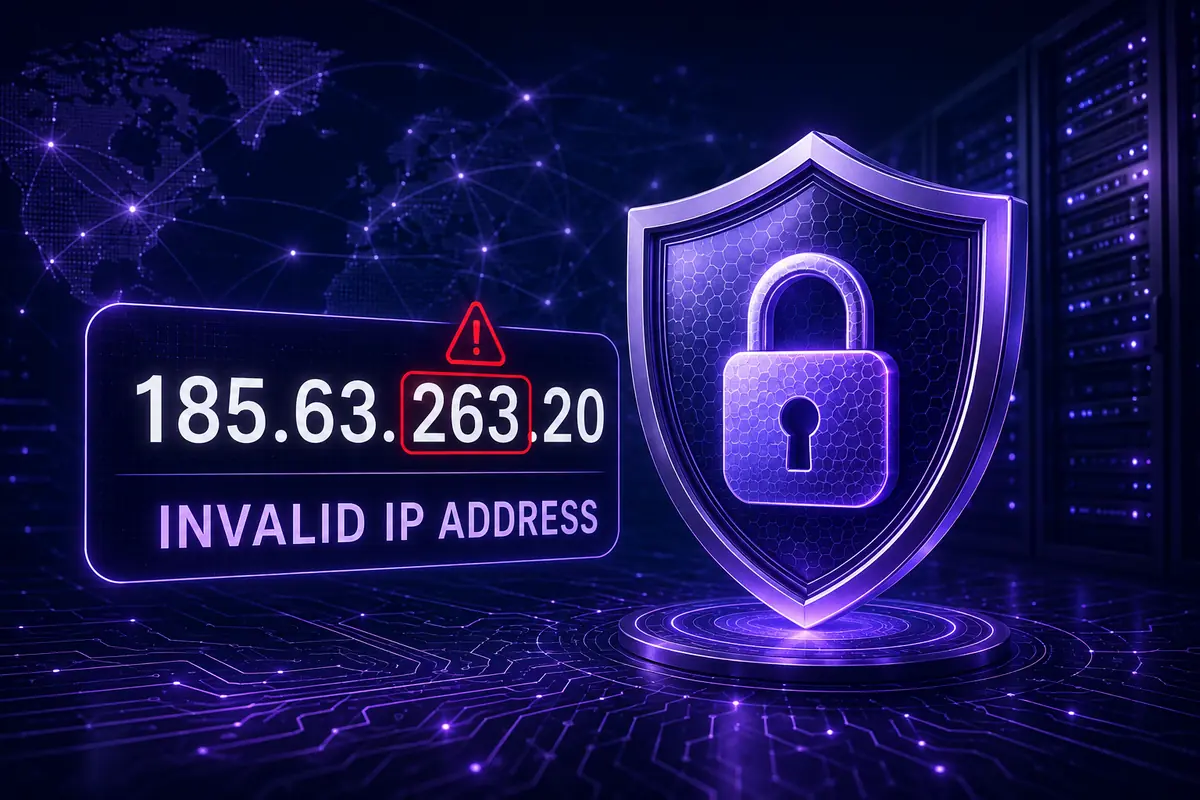
At first glance, 185.63.263.20 looks like a standard IPv4 address. It contains four numerical sections separated by dots, which is the familiar format used for many internet addresses. However, a closer technical check reveals an important problem: this address is not valid. The third section contains the number 263, while an IPv4 section can only hold a value from 0 to 255. Therefore, the address cannot identify a legitimate device, website, server, or public network location in its current form.
This distinction matters because unfamiliar numerical addresses often cause concern. A person may encounter one in an email, server log, website report, advertisement, message, or cybersecurity warning and assume it represents a suspicious host. In this case, there is no valid IPv4 endpoint to investigate. The more useful questions are where the string appeared, whether it contains a typing error, and whether someone used it to disguise a questionable link or technical instruction.
Why It Is Not a Valid IPv4 Address
An IPv4 address is a 32-bit identifier divided into four 8-bit sections known as octets. Each octet can represent a decimal number between 0 and 255. A correctly formatted address might look like 192.0.2.25, with every section staying within the permitted range. According to RFC 3779, IPv4 addresses are written as four decimal numbers separated by periods, and every number must fall between 0 and 255.
The third octet of 185.63.263.20 exceeds that maximum by eight. As a result, standards-compliant browsers, routers, operating systems, IP lookup services, and security tools should reject it or classify it as malformed input. It cannot be assigned through the normal IPv4 allocation system. There is consequently no reliable hosting company, geographic location, autonomous system, or network owner associated with the complete string.
What the Four Sections Normally Represent
Each part of an IPv4 address contributes eight bits to its total 32-bit value. Since eight binary bits can produce 256 possible combinations, the decimal range begins at 0 and ends at 255. A value of 263 cannot fit inside one octet. This is a structural limitation of the protocol rather than a restriction imposed by a particular internet provider or country.
The dots do not automatically make every four-part numerical string an IP address. Validity depends on both format and range. Each part must contain an acceptable decimal value, and the complete address must be processed according to the relevant networking rules. This is why a string can look technically convincing while still being unusable. Visual appearance alone is not enough to establish that an address is genuine.
Common Reasons This String May Appear
A simple typing mistake is the most likely explanation. Someone may have intended to enter a similar address but accidentally typed 263 instead of a valid value. Copying information from a screenshot, scanned document, handwritten note, or low-quality image can also introduce errors. Optical character recognition software sometimes misreads digits, especially when the original text is blurred or compressed.
Another possibility is that the string was generated automatically. Poor validation in a form, script, spreadsheet, database, or content generator can produce numbers that look like addresses without checking the permitted range. Developers sometimes use deliberately invalid values as examples or placeholders. In a less harmless situation, a deceptive message may include a malformed address to appear technical, create urgency, or persuade the recipient to run a command.
It Cannot Be Geolocated Reliably
A valid public IP address may sometimes be associated with an internet service provider, approximate region, or autonomous system. Those details are obtained from allocation records, routing data, and commercial geolocation databases. Because 185.63.263.20 is outside the valid IPv4 range, normal lookup results cannot reliably identify its country, city, server, or owner.
Any website claiming to provide an exact location for the complete string should be treated cautiously. It may be ignoring the invalid octet, altering the input, displaying cached information, or returning a general result based only on part of the address. IP geolocation is approximate even for legitimate addresses, and it should never be treated as proof of a person’s identity or precise physical location.
Does the Address Present a Direct Security Threat?
The malformed string itself cannot establish a normal internet connection because it does not represent a valid endpoint. That means it cannot independently host a website, receive standard IP traffic, or operate as an ordinary command-and-control server. Still, the surrounding context may create a security concern. A suspicious email, script, attachment, browser redirect, or system alert containing it deserves attention even though the address is invalid.
Attackers occasionally rely on confusing technical content to make a message seem credible. They may also expect a user to correct an apparent typo, visit a similar address, download software, or paste a command into a terminal. The safest response is to examine the complete message or event rather than focusing only on one malformed value. An invalid indicator does not automatically make everything around it safe.
Why You Should Not Guess the Intended Address
It may be tempting to replace 263 with 263 minus 256, change it to 255, or select a nearby number. None of those changes can reveal what the sender originally intended. A single altered digit can lead to an entirely different network controlled by an unrelated organization. Guessing could therefore direct a browser or diagnostic tool toward an innocent or unsafe system.
If the value came from a trusted colleague, service provider, or system administrator, request the original address through a verified communication channel. If it appeared in a configuration file, compare it with approved documentation or a known working version. When it comes from an unsolicited message, avoid correcting and opening it. Preserve the original text so the full context can be reviewed accurately.
Safe Ways to Check an Unfamiliar IP Address
Begin with format validation rather than a live connection. Confirm that the string has four decimal sections and that every section falls between 0 and 255. Reputable IP lookup services should only be used after the input passes this basic check. An address should not be opened directly in a browser simply because its structure appears familiar.
For a valid but unfamiliar address, investigate its registration and reputation through trusted sources. WHOIS or Regional Internet Registry data may identify the organization responsible for the address range, while security platforms may report previous abuse. Reputation is only one signal, however. An address can be newly compromised, shared by many customers, reassigned, or incorrectly reported. Evidence from firewall logs, timestamps, ports, protocols, and application activity provides a stronger basis for a decision.
How Developers Should Validate Address Input
Applications that accept IP addresses should rely on a standard networking library rather than a loose regular expression. A weak pattern may confirm only that four groups of digits and three dots are present. It may therefore accept values above 255. A proper parser checks the numerical range, overall structure, address family, and other relevant rules before storing or using the value.
Validation should take place on the server even when a form also checks input in the browser. Client-side controls can be bypassed. Invalid input should generate a clear error and should not be silently transformed into another address. Developers should also store the original rejected value in appropriate diagnostic logs when needed, while avoiding unnecessary collection of personal or sensitive data.
Handling the Address in Security Logs
If 185.63.263.20 appears in a firewall, application, or access log, first determine which field contains it. It might not be the source address recorded by the network stack. It could be user-supplied text, a manipulated HTTP header, a search query, an invalid form entry, or content stored by an application. Fields such as X-Forwarded-For can also contain untrusted values unless they are added and controlled by a known proxy.
Review the event timestamp, hostname, request path, user agent, authentication status, and nearby entries. The actual connection source should be taken from trusted network or proxy metadata. A malformed address in an untrusted field may indicate probing, poor software, or an attempt to confuse logging and analysis. It is evidence worth contextualizing, but it is not enough on its own to prove an intrusion.
Sensible Protection Measures
Keep browsers, operating systems, routers, security software, and internet-facing applications updated. Use multi-factor authentication on important accounts, avoid opening unexpected attachments, and do not paste unknown commands into a terminal. Network administrators should maintain centralized logs and configure alerts for repeated validation failures, suspicious authentication attempts, and unusual outbound connections.
When a valid address is confirmed as malicious through reliable evidence, organizations can consider blocking it at the firewall, proxy, or security gateway. CISA guidance recommends developing a process for blocking domains and IP addresses identified as supporting attacks. Blocking should be documented and reviewed because addresses can change ownership, host multiple services, or become harmless later.
Difference Between Invalid and Malicious
“Invalid” describes a technical condition, while “malicious” describes harmful intent or activity. The focus keyword is invalid because one octet exceeds the maximum IPv4 value. That fact does not tell us who created the string or why it appeared. It may result from an ordinary mistake, faulty software, intentionally fabricated data, or deceptive content.
Security decisions should be based on context and corroborating evidence. An invalid address found in an old document is usually a data-quality issue. The same string inside a phishing email, unauthorized configuration change, or repeated injection attempt may support a broader security investigation. Separating formatting errors from actual threats helps prevent unnecessary panic and improves the accuracy of incident response.
Final Assessment
185.63.263.20 cannot function as a valid IPv4 address because 263 falls outside the allowed 0–255 range. It therefore has no dependable IP owner, hosting provider, physical location, or live server identity in its present form. Claims about its exact country, operator, or threat history should not be trusted unless the original value is corrected and independently verified.
The appropriate response is not to guess what the address was supposed to be. Check its source, preserve the surrounding information, validate related logs, and ask a trusted sender to confirm it when necessary. If it appeared alongside suspicious links, files, login requests, or commands, treat the complete event cautiously and report it to the relevant administrator or security team.
FAQs
Is 185.63.263.20 a real IP address?
No. It is not a valid IPv4 address because its third section is 263, while every IPv4 octet must be between 0 and 255.
Can this address reveal someone’s location?
No reliable location can be obtained from it. Since the address is malformed, standard allocation and geolocation records do not apply to the complete string.
Is the address automatically dangerous?
Not by itself. It cannot operate as a normal IPv4 endpoint, but a message, file, or command containing it could still be suspicious.
Should I correct the 263 and open the address?
No. Guessing a replacement number may lead to an unrelated system. Confirm the correct value through a trusted source instead.
What should I do if it appears in my server logs?
Check which log field contains it, review nearby events, and compare it with the trusted connection-source field. Report suspicious activity to your system administrator.
More Details : 30.6Df496–J261X5 in Food: What This Mysterious Code Really Means